Hiphop & classical music
Hip-Hop & Classical Music
Hip-hop is often seen as a genre that exists outside the world of classical music. Yet for years now, it has played a substantive role within the practice of contemporary composers and conservatories, and it has grown into an important reference point for progressive classical music festivals. Not as a style or a “cross-over,” but as a way of thinking about time, form, and sound.
Beat
One of the core ideas of hip-hop is beat-based thinking. Whereas the classical tradition often starts from melodic development and harmonic tension, hip-hop works with repetition, cycles, and groove. A beat is not a background element, but the foundation on which everything rests. Contemporary composers adopt this principle by building music from loops, patterns, and gradual changes in density, timbre, and energy. This approach aligns with a broader development in new music, in which process and structure have become more important than narrative or thematic development.
Composition Education
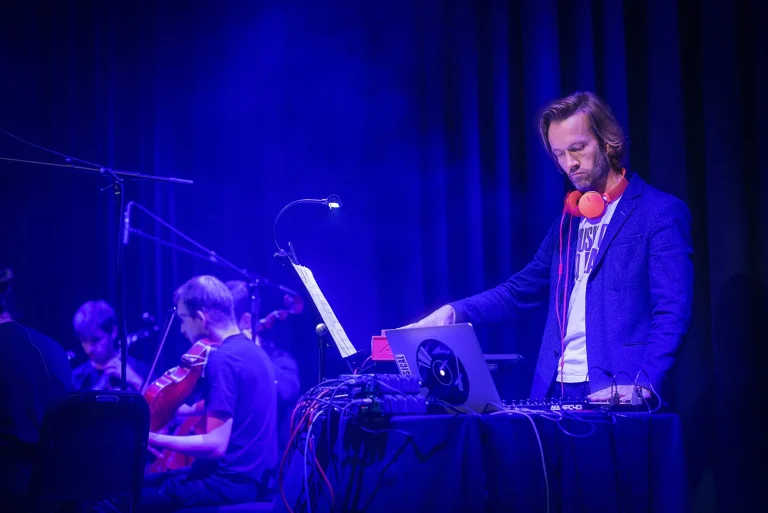
Within conservatories, this influence is clearly visible. Composition students increasingly work from a producer mentality: they begin in a digital environment, build up layers, experiment with textures, and only later translate that material (sometimes only partially) into notation. In this context, the score is not always the final goal, but one of the means of making music transferable. This connects with the practice of composers such as Gabriel Prokofiev, who brings together club culture, turntablism, and orchestral music without reducing hip-hop to a stylistic feature.
Sampling
Hip-hop consciously and creatively builds on existing material. Its dialogue with the past is one of adaptation, transformation, and appropriation. Classical music has that tradition too — Bach, Brahms, and Beethoven all relied heavily on what came before them — but the contemporary classical world sometimes treats the repertoire more as sacred heritage than as living material to play with. (Tip: Een flat met duizend ramen uses a form of sampling and is an exception in this regard.)